Skip to main content Skip to search Skip to main navigation
callback

Everything at a glance


Here you will find comprehensive details about the ISC series, including informative videos, a wide range of accessories for your vacuum cleaner and all technical documents to download.

Discover everything you need to know about the ISC series and your vacuum cleaner and optimize your user experience!

ISC series vacuum cleaners


Skip product gallery
NEW
Wet/Dry Vacuum Cleaner ISC L-1418 mono

Compact wet and dry vacuum cleaner with high performance and dust class L – ideal for renovation and interior finishing work.

Regular price: EUR546.21
NEW
Wet/dry vacuum ISC L-1425 mono

Compact wet/dry vacuum cleaner with high performance and dust class L – ideal for renovations and interior finishing work.

Regular price: EUR593.81
NEW
ISC M-1418 mono Wet & Dry Vacuum Cleaner

Compact wet & dry vacuum cleaner with powerful performance and Dust Class M certification – ideal for renovation projects and interior finishing.

Regular price: EUR629.51
NEW
Wet/dry vacuum ISC H-1425 mono

Compact wet and dry vacuum cleaner with high performance and dust class H – ideal for renovation and interior finishing work.

Regular price: EUR689.01
Universal vacuum cleaner - ISC L-1650 Top

Power tool vacuum cleaner (wet/dry), for class L dusts. With extra large container volume, 50 liters.
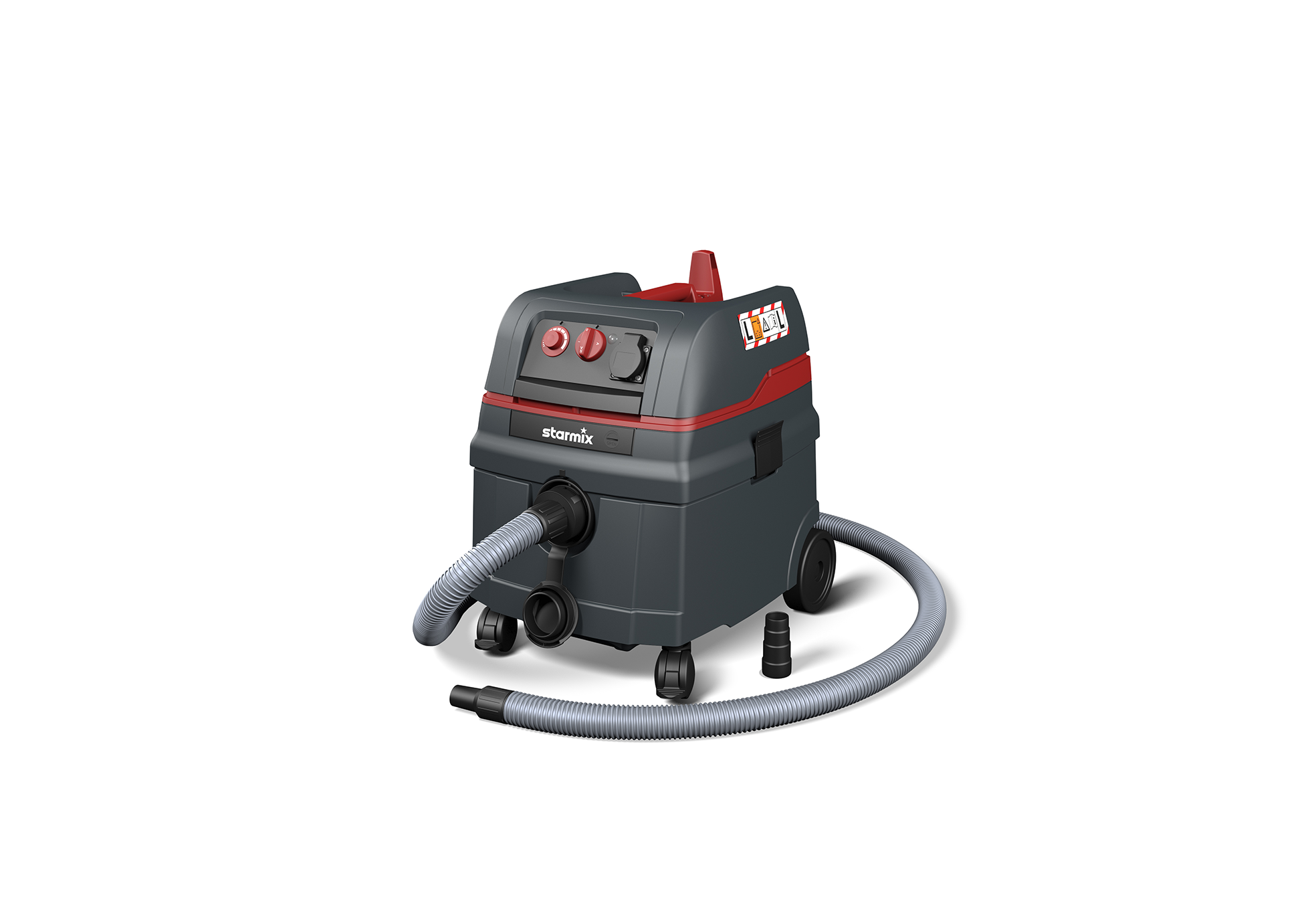
Regular price: EUR993.65
Universal vacuum cleaner - ISC L-1625

Power tool vacuum cleaner (wet/dry)

Regular price: EUR772.31
Universal vacuum cleaner - ISC M-1625 Safe

Special vacuum cleaner class M

Regular price: EUR934.15
Universal vacuum cleaner - ISC L-1625 Top

Power tool vacuum cleaner (wet/dry)

Regular price: EUR827.05
Battery vacuum cleaner - ISC BATRIX M 36-18V

Battery wet-dry vacuum cleaner for class M dusts. Up to 100 minutes running time. Up to 300 € BG-Bau promotion.

Regular price: EUR1,010.31
Battery vacuum cleaner - ISC Batrix L 36-18V

Battery wet-dry vacuum cleaner for class L dusts. With up to 100 minutes run time.

Regular price: EUR891.31

Do you need help or have questions about your vacuum cleaner?

Good question - clear answer

Here you will find the most frequently asked questions answered briefly and clearly. Do you have any other questions? We will be happy to answer your questions personally.


GENERAL


pH values from 5 (slightly acidic) to 8 (slightly alkaline). With regard to the type of liquids to be absorbed, the user must observe the composition of the data sheet and consult Electrostar if necessary. Keywords: Note flash point. Liquids such as drilling emulsion may corrode filters and seals.

The temperature of the material sucked in must not exceed +60°C, or there must be no residual embers in the material sucked in. No flammable, explosive or burning substances or liquids may be sucked in.

If the vacuum cleaner is to extract at two extraction points, only a reduced volume flow is available in each case. Two hoses are connected via a Y-piece (Ø 35 mm / item no. 425689). To obtain a higher volume flow, we recommend our 2 or 3-motor vacuum cleaners GS 2078 / GS 3078.

Yes, the various water level detection systems, using electrode shut-off or floats, also switch off effectively when foam is present. There may initially be more moisture in the blow-out air until the switch-off occurs. However, the vacuum cleaner is not damaged.

The automatic switch-on function responds from a power of 100 watts. The maximum output is 2,000 watts - this information is labeled on the inside of the socket cover.

We recommend the use of hoses up to a total length of max. 10 m.

Rule of thumb: light (bulky) items to be vacuumed (e.g. paper cuttings, leaves, dust) --> low air speed --> large suction hose Ø. Heavy debris (coarse sand, stones, screws) --> high air speed --> small hose diameter

On all appliances with an appliance socket, the vacuum cleaner switches on and off automatically with the connected power tool in the “A” or “AR” switch position. This allows the dust to be conveniently extracted directly at the source. Before the vacuum cleaner switches off, it continues to run for approx. 10 seconds to ensure that the suction hose is completely emptied.

The reduced starting currents due to the soft start of the suction motor prevent the house fuse from tripping. The reduced load also increases the service life of the motor.

Antistatically prepared appliances have an electrically conductive inlet fitting that is connected to the earthing conductor. When vacuuming up fine dust (friction) and depending on the air humidity (e.g. dry air in winter), electrostatic charges can build up in the suction hose, which then discharge with the formation of sparks - harmless but unpleasant. The electrostatic attraction forces also increase the soiling of the suction hose. An anti-static suction hose (AS) is required as effective protection against this - the charges are discharged immediately and imperceptibly.

Up to 2.5 m when only water (without air) is sucked in - the suction pipe is completely under water (full suction mode). The maximum suction height is up to 8 meters when a water-air mixture is sucked in (“sip mode”).

Discharge takes place via an antistatic suction hose, the conductive inlet fitting and then via the protective earthing of the vacuum cleaner.

To bridge a larger distance, 2 suction hoses can easily be connected together (pipe connection in bayonet connection) - but only up to a total length of 10 m, otherwise suction power may be lost.

No. Only the supplied hose can be connected to the Batrix. The container and hose are coded to protect the electronics from damage. The Quadrix can also only be connected using the hose supplied.

The transmitter strap is attached either around the suction hose or the power tool. Set the vacuum cleaner to AUTO, the vacuum cleaner starts and stops when the power tool starts and stops. Note: The closer the transmitter is attached to the power tool, the more accurate the vibration detection will be. If it is necessary to pair the transmitter with the vacuum cleaner again: Press the button on the transmitter until it lights up blue to pair the transmitter with the vacuum cleaner.

Filters from the gray market often not only have a poor fit, but also cheap, inadequate bonding or welding. These filter bags do not meet the Starmix test requirements! The consequences can be: Leakage or bursting. The dust is then in the container and you could just as well have vacuumed without the bag, i.e. supposedly cheap third-party suppliers are still too expensive! Caution: The guarantee is void if replacement parts, accessories or consumables not approved by us are used, in particular pleated filter cassettes or cartridges or filter bags. The use of these filters, which have not been tested by us, can lead to damage, particularly to the turbine.

A filter bag is usually made of a special non-woven material and is completely closed. A disposal bag, on the other hand, is made of film material - similar to a bin liner. It is open at the top and is inserted into the container in such a way that the edge of the bag protrudes slightly over the edge of the container and can be folded over. Only the safety vacuum cleaners (M-/H-/Asbestos) of the ISP/ISC series with special container and rotary valve are suitable for use with PE disposal bags. Typical applications include work where large quantities of fine dust are produced, such as when sanding plasterboard filler.

HEPA stands for “High Efficiency Particulate Air Filter”. It is a classification of filtration according to EN 1822, which comes from the field of air filtration (rooms/respiratory masks) and cannot be compared with the criteria that apply to the filtration of dusts to be sucked up in industrial vacuum cleaners according to IEC 60335-2-69, where far higher demands are placed on the filters, e.g. with regard to air velocity, pressure difference and mechanical load. However, HEPA is widely used in various countries/markets and especially for household vacuum cleaners. In simple terms, it can be said that a HEPA filter H14 corresponds to an H filter in terms of dust retention capacity (99.995%) according to IEC 60335-2-69.

ISP and ISC appliances can be wet-suctioned with the standard built-in pleated filter cassettes made of polyester filter material. On appliances with a round container (uClean/eSwift/HS/GS/AS series) - due to their design, the filter is in contact with the water - small amounts of liquid sucked up are no problem for the polyester pleated filter. However, residual water should be removed before the next dry vacuuming if possible. In the event of frequent changes (use as a wet/dry vacuum cleaner), we recommend using 2 pleated filters - one for wet and one for dry. If only water is being vacuumed, the folder filter must be removed and the foam filter FSS 1200 - 413297 inserted (only for uClean/eSwift/HS/GS/AS series). Cellulose filters (paper) are unsuitable. The Starmix fleece filter bags are tear-resistant and insensitive to damp dirt, but are not suitable for vacuuming sludge or liquids.

When the suction power decreases rapidly and - depending on the vacuum cleaner model - when the filter indicator light comes on. If the filter is a polyester or NANO filter, any dust that has become trapped can be washed out. Do NOT blow out filter cassettes with compressed air! If the dust is hazardous to health, the filter must not be knocked out or washed out.

No. M and H vacuum cleaners are tested by the test center as a complete device and have, among other things, special electronics that detect when the air speed drops below 20 m/s due to clogged filters or a blocked suction hose. Sufficient extraction is then no longer guaranteed and an acoustic warning signal sounds. Work can only continue once the cause has been checked and eliminated.

A dust-air mixture can explode if the following three components come into contact in or around the appliance: Dust (a certain dust concentration is required) Air (oxygen) Ignition source (a minimum ignition energy must be exceeded) E.g. grinding of aluminum, magnesium or vacuuming of e.g. flour, paper dust, soot dust. Protective measures must be taken for combustible dusts. The customer must check whether a zone is present. Starmix does not currently offer devices for explosive dusts.

BATRIX


All 18V or 36V batteries from the CAS system (Cordless Allicance System) can be used. Please note the different runtimes with an 8.0 or 10.0 Ah battery.

The battery indicator is located on the front panel of the vacuum cleaner and is always illuminated during operation: 5 LEDs = 100% capacity 3 LEDs = 60% capacity 30 seconds before the battery is empty, the last LED flashes for 3 seconds and a horn signal sounds (only for M vacuum cleaners)